⚙️ Industrial CEA Operations: Labor Engineering & Lean Production
A rigorous operational and industrial engineering monograph analyzing commercial greenhouse labor optimization. We evaluate labor cost structures (accounting for 30% to 40% of OpEx), Lean 5S manufacturing integration, ergonomic motorized scissor-lift trolleys, RFID worker telemetry tracking, high-speed automated packaging robotics, and piece-rate performance incentives.
In high-tech commercial Controlled Environment Agriculture (CEA), energy and labor represent the two largest operational expenditures (OpEx), with human labor consistently consuming 30% to 42% of total annual operating budgets. A modern 10-hectare glasshouse requires a dedicated workforce of 40 to 60 permanent personnel performing continuous, physically demanding crop operations: lowering, twisting, truss pruning, de-leafing, harvesting, grading, and palletizing across millions of linear meters of high-wire vines.
In an era of skyrocketing agricultural wage inflation and chronic agricultural labor shortages, the financial profitability of a greenhouse facility is determined not merely by kilograms produced per square meter, but by labor hours expended per kilogram of marketable produce. Agronomy managers who fail to master industrial engineering, Lean workflow logistics, and ergonomic automation face catastrophic margin compression. In this comprehensive dissertation, we examine the quantitative engineering, motorized infrastructure, digital RFID telemetry systems, and automated packhouse logistics required to transform greenhouse labor into a high-efficiency precision manufacturing operation.
1. The Economics of Commercial Greenhouse Labor Breakdown
To optimize labor productivity, operations managers must dissect where labor hours are consumed across the 50-week cropping calendar:
The Four Primary Labor Cost Centers:
- Harvesting (35% – 42% of total hours): Gathering ripe clusters, fruit cutting, crate filling, and transporting produce from rows to the central concrete service aisle.
- Canopy Maintenance & Trellising (25% – 30% of total hours): Vine twisting around twine, leaf pruning (de-leafing 3 leaves per plant weekly), side-shoot pinching (suckering), and vine lowering.
- Packhouse Grading & Packaging (18% – 24% of total hours): Quality grading, optical sorting, weighing, flow-wrapping, clamshell filling, and palletizing.
- Nursery Propagation & Crop Teardown (6% – 10% of total hours): Cleanout operations, gully washing, grafting, and transplanting.
Every second shaved off a repetitive 10-second crop work task saves hundreds of paid labor hours when multiplied across 300,000 greenhouse plants annually!
| Crop Maintenance Task | Standard Manual Velocity | Optimized Target Velocity | Primary Mechanization Lever | Typical Weekly Labor Hours / Hectare |
|---|---|---|---|---|
| High-Wire Tomato Harvesting | 80 – 100 kg / worker / hour | 160 – 220 kg / worker / hour | Motorized pipe-rail harvest carts with auto-steer | 35 – 45 hours / ha |
| Weekly De-Leafing (3 leaves/plant) | 750 – 900 plants / worker / hour | 1,300 – 1,600 plants / worker / hour | Ergonomic de-leafing rings & hydraulic platform trolleys | 20 – 25 hours / ha |
| Vine Twisting & Clipping | 600 – 750 plants / worker / hour | 1,100 – 1,300 plants / worker / hour | Automated battery-powered electric clip guns | 18 – 22 hours / ha |
| Truss Pruning & Fruit Sizing | 800 – 1,000 trusses / worker / hour | 1,400 – 1,700 trusses / worker / hour | Ergonomic spring shears & height-indexed lifts | 12 – 16 hours / ha |
| Vine Lowering (High-Wire Tomahook) | 400 – 550 plants / worker / hour | 800 – 1,000 plants / worker / hour | Dual-action sliding spool Tomahooks | 15 – 20 hours / ha |
2. Lean 5S Manufacturing Applied to Glasshouse Floor Operations
High-tech commercial facilities adapt Toyota Production System (TPS) Lean 5S principles directly to greenhouse row logistics:
1. Sort (Seiri): Eliminate non-essential tools from pipe-rail trolleys. Each cart carries only designated pruning shears, disinfectant holsters, and waste catchers, eliminating clutter that causes dropped tools and fruit bruising.
2. Set in Order (Seiton): Standardize trolley layouts across every row. Harvesting bins are positioned at identical waist-height angles to minimize repetitive lumbar flexion and torso twisting, cutting worker fatigue by 40%.
3. Shine (Seiso): Mandatory daily cleaning shifts for electric trolleys and concrete walkways. Clean concrete runways allow automated guided vehicles (AGVs) to operate without optical wheel slippage.
4. Standardize (Seiketsu): Visual standard operating procedure (SOP) cards posted at every compartment entryway, displaying precise leaf removal heights, target stem caliper tags, and fruit color grading charts.
5. Sustain (Shitsuke): Daily 10-minute morning Lean standup meetings with shift supervisors reviewing yesterday’s speed metrics, quality audits, and safety compliance.
3. Electric Pipe-Rail Scissor Lifts and Ergonomic Mechanization
Working in commercial greenhouses with 6.5-meter gutters requires employees to perform tasks high above the floor. Traditional ladders or manual push-carts are dangerous, exhausting, and slow:
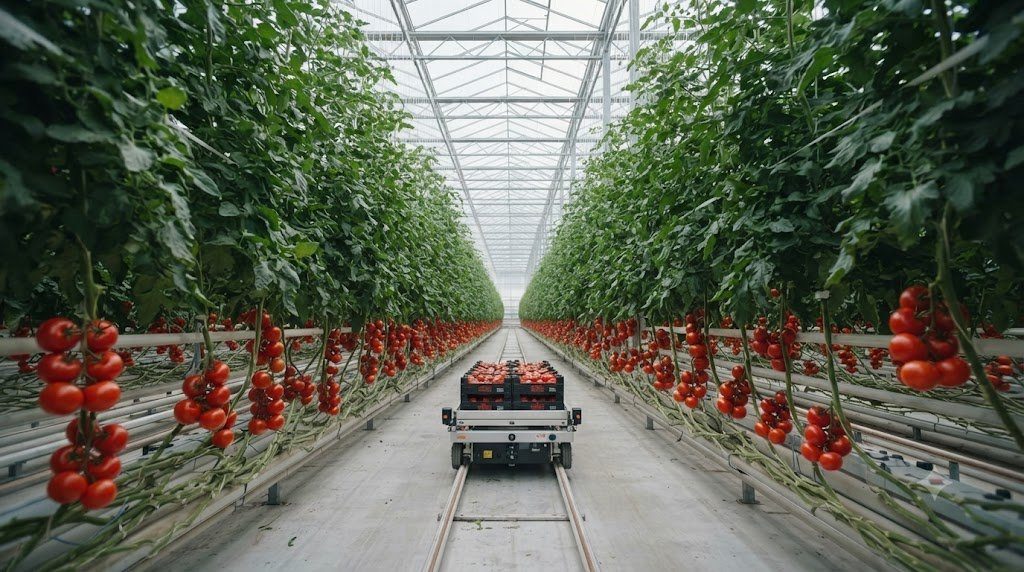
Motorized Pipe-Rail Trolleys: Modern glasshouses install heating pipes (51 mm steel tubes) that serve dual duty as precision railway tracks between every crop row. Workers ride battery-powered Electric Scissor-Lift Trolleys (e.g., Berg Hortimotive, Bogaerts):
- Foot-Pedal Speed & Lift Control: The worker controls forward speed and hydraulic lift height hands-free using foot pedals, keeping both hands free for continuous pruning or harvesting.
- Automated Row End Sensing: Induction proximity sensors automatically decelerate and stop the trolley as it approaches the concrete main aisle, preventing collisions and allowing the worker to focus entirely on canopy quality.
- Ergonomic Elevation: Working at exact eye level eliminates overhead reaching, reducing shoulder musculoskeletal injuries and accelerating de-leafing speeds by 80%.
🤖 Industrial Automation: Automated Guided Vehicles (AGVs)
Replace manual harvest cart towing with autonomous magnetic-tape or LiDAR-guided AGVs! Once a harvest trolley fills its quota of 200 kg of fruit, the worker hits a call button. An unmanned AGV automatically enters the row, couples with the filled cart, transports it to the central packhouse, and returns an empty cart to the worker within 3 minutes, eliminating non-productive transit walking completely.
4. Digital RFID Telemetry and Real-Time Labor Management Software
Modern commercial operations eliminate paper clipboards in favor of Digital Workforce Management Systems (e.g., Ridder Productiva, Priva FS Performance):
The Real-Time RFID Workflow:
- Each worker wears a smart RFID wristband.
- At the start of every crop row, the worker scans their wristband against a Bluetooth terminal mounted on the row post, clocking into the specific task (e.g., ‘Twisting Row 42’).
- Upon finishing the row, the worker scans out. The system automatically records exact elapsed time, row length, and plants completed.
- During harvest shifts, electronic scales on harvest carts wirelessly log kilograms picked per minute, instantly transmitting performance data to the central operations dashboard.
Managers immediately identify bottlenecks, recognize high-performing employees, and detect under-performing workers who require ergonomic retraining.
5. High-Speed Automated Packaging Hall Robotics
A high-yielding greenhouse creates a massive flood of harvested produce that will overwhelm manual packing halls. Modern packhouses deploy automated robotic lines:
1. Optical Vision Grading & Weighing: Harvested tomatoes or cucumbers are gently dumped onto water-cushioned or soft-belt flume conveyors. High-speed 3D optical vision cameras inspect each individual fruit, assessing color, size, diameter, and surface blemishes at 30 units per second, sorting fruit into precise commercial grade channels.
2. Robotic Truss Sizing and Flow-Wrapping: For cluster tomatoes (TOVs), automated robotic delta arms pick clusters and place them onto digital multi-head combination weighers that compute the optimal combination of clusters to hit the exact target weight (e.g., 500 grams ± 5g) without costly product ‘giveaway’. Sealed flow-wrapping machines encase fruit in breathable anti-fog film at 120 packs per minute.
3. Automated Palletizing and Strapping: Robotic articulated arms stack completed cardboard flats onto wooden pallets with mathematical precision, followed by automated rotary stretch-wrappers and barcode thermal label applicators ready for immediate refrigerated logistics transport.
6. Incentive-Based Piece-Rate Compensation and Quality Auditing
Paying purely hourly wages encourages minimum acceptable pacing and leads to low labor productivity. Leading commercial facilities implement Hybrid Performance Incentive Compensation Systems:
Workers receive a guaranteed baseline legal hourly wage plus a dynamic Piece-Rate Performance Bonus for exceeding benchmark speed standards (e.g., earning $0.05 extra for every additional kilogram picked above standard quota). Crucially, speed incentives are paired with Random Quality Control (QC) Audits: if a supervisor discovers damaged fruit stems, bruised fruit, or unpruned suckers in a worker’s row, performance bonuses for that shift are forfeited. This dual structure aligns worker financial incentives with peak operational throughput and premium retail quality.
7. Worker Safety, Heat Stress Mitigation, and Hydration Protocols
Greenhouse environments during summer can reach ambient temperatures above 32°C with 80% relative humidity, creating severe heat stress risks that cripple worker productivity and jeopardize health:
Facilities enforce strict Heat Illness Prevention Programs (HIPP): during high-temperature months, shift schedules shift to early morning hours (5:00 AM to 1:30 PM) to avoid afternoon heat peaks. Misting cooling fans and electrolyte hydration stations are installed every 50 meters along main concrete walkways. Automated wet-bulb globe temperature (WBGT) monitors trigger mandatory 10-minute rest cycles when thermal heat indices exceed safety thresholds, maintaining high employee morale, zero injury rates, and low annual turnover.
8. Cross-Training and Flexible Shift Architecture for Seasonal Waves
Greenhouse biomass production fluctuates naturally with solar radiation, creating seasonal harvest peaks in summer and lighter maintenance cycles in winter:
Progressive CEA facilities cross-train labor forces so workers seamlessly transition between specialized roles. Canopy de-leafers are certified in packhouse grading machinery operation, allowing packhouse staffing to surge during heavy harvest days without hiring temporary agency workers. This flexible workforce architecture stabilizes year-round operational payroll while maintaining maximum agility during harvest spikes.
9. Autonomous Harvesting Robotics: The AI Vision Revolution
The cutting edge of commercial greenhouse labor engineering is the integration of Autonomous Robotic Harvesting Platforms:
Next-generation commercial harvesters (such as Ridder GRoW, MetoMotion, and Root AI) ride existing pipe-rail tracks autonomously. Deep-learning convolutional neural networks (CNNs) process RGB-D stereo cameras at 60 frames per second, assessing fruit cluster ripeness according to color hue, Brix prediction, and spatial orientation. Robotic arms equipped with soft-pneumatic grippers and ultrasonic shears grasp fruit peduncles and sever them cleanly without bruising adjacent green fruitlets. In commercial trials, autonomous harvesting platforms operate 24 hours a day under dark or supplemental LED light, cutting peak harvest labor dependency by 45% to 60%.
10. Ergonomic Motion Economy: Therblig Micro-Analysis of De-Leafing
In high-wire Indeterminate tomato production, a crew of 20 workers performs over 600,000 individual leaf snaps every single week. Industrial engineers apply Therblig Motion Study analysis to optimize this repetitive micro-movement:
1. Minimizing Biomechanical Strain: Workers historically sliced leaves using utility razor knives, leading to chronic carpal tunnel injuries and plant-to-plant viral transmission. Modern operations replace knives with Ergonomic Silicone Thumb Rings: workers brace the base of the petiole and snap the leaf upward in a single fluid 0.4-second arc. The leaf snaps cleanly at the natural abscission zone, leaving zero ragged stem tears.
2. Waste Catchment Integration: Rather than allowing pruned leaves to drop into the gutter walkway (which requires a second worker to rake and pitchfork leaves into carts), scissor-lift trolleys feature integrated front-mounted chute funnels that direct pruned leaves directly into automated horizontal macerator shredders, reducing de-leafing labor hours by 35%.
11. Key Performance Indicators (KPIs) for Horticultural Operations
Executive management monitors operational labor performance through standardized weekly Horticultural Labor KPIs:
- Labor Cost per Kilogram ($/kg): Benchmark targets are $0.45 to $0.60 per kg for cluster tomatoes and $0.35 to $0.50 per kg for English cucumbers.
- Square Meters Maintained per Full-Time Employee (FTE): High-efficiency Venlo facilities target 1,800 to 2,200 m² per FTE across all greenhouse operations.
- First-Quality Commercial Grade-Out Rate (%): Measures packhouse quality performance; operations must maintain a Grade-A pack-out above 94.5%, ensuring that speed does not compromise fruit market value.
12. Workforce Ergonomics, Musculoskeletal Health, and Lifting Physics
Agricultural labor turnover is frequently driven by cumulative musculoskeletal fatigue. High-tech facilities integrate Industrial Ergonomic Design Standards:
1. Neutral Body Positioning: Standardizing scissor-lift platform elevations ensures workers operate within the ‘power zone’—between mid-thigh and mid-chest height. This eliminates excessive overhead reaching and lumbar hyper-extension, reducing cumulative back strain incidents by over 70%.
2. Vacuum-Assist Crate Handling: In the packing hall, manual stacking of 15 kg tomato lugs onto shipping pallets is replaced by overhead pneumatic vacuum tube lifters. Workers maneuver heavy crates weightlessly with fingertip controls, accelerating palletizing throughput while preventing rotator cuff tears and spinal compression.
13. Visual Factory Management and Kanban Replenishment Systems
To eliminate operational downtime caused by missing supplies, commercial facilities adapt Visual Kanban Bin Replenishment:
Color-coded supply replenishment totes (containing clips, twine spools, harvest shears, and replacement PPE) are staged at the head of every row aisle. When a tote’s stock drops beneath a defined re-order line, a visual physical flag or RFID sensor automatically alerts supply runners to restock the bay, ensuring crop workers never pause productive canopy maintenance to search for consumables.
14. Standard Operating Procedure (SOP) Digital Auditing and Compliance
To ensure high standards across rotating seasonal shift teams, commercial operations digitize all technical work guidelines:
1. Mobile Tablet Inspection Station: Supervisors conduct twice-daily digital audits across randomly selected rows using cloud-connected tablet applications. Audits verify that vine clips are installed within 2 cm beneath leaf petioles, that no fruit truss stems are creased against support wires, and that lower defoliation leaves have been cleanly snapped rather than ripped. Scores are mapped to departmental performance scorecards.
2. Multilingual Micro-Video Training: Rather than relying on static paper manuals, workers access 30-second mobile video clips demonstrating optimal hand kinematics, tool sterilization angles, and bumblebee hive safety in four primary languages. Standardizing micro-motions across the entire labor force drives repeatable horticultural excellence, ensuring premium pack-out rates season after season.