🍓 Commercial Berry Horticulture: High-Tech Protected Strawberry Cultivation
An advanced agronomic treatise detailing commercial Controlled Environment Agriculture strawberry production (Fragaria × ananassa). We analyze day-neutral vs. June-bearing photoperiod genetics, suspended tabletop ergonomic gutter engineering, bumblebee vs. honeybee buzz pollination, runner suppression protocols, and crown temperature chilling physics.
Commercial strawberry production (Fragaria × ananassa) is undergoing a monumental global transition away from traditional open-field soil cultivation toward High-Density Controlled Environment Agriculture (CEA). Field-grown strawberries are acutely vulnerable to severe weather damage, soil-borne fungal pathogens (Verticillium, Phytophthora, Colletotrichum), and extreme harvest labor inefficiencies that require workers to bend continuously over dirt furrows. Furthermore, open-field berry quality fluctuates wildly in size, firmness, and sweetness.
High-tech commercial greenhouse strawberry production transforms berry cultivation into a precision industrial manufacturing process. By cultivating specialized day-neutral cultivars within suspended ergonomic tabletop gutters, controlling root-zone crown temperatures, optimizing Daily Light Integrals (DLI), and orchestrating precision bumblebee pollination, modern commercial facilities achieve continuous 10-month harvest cycles producing over 12 to 16 kilograms of premium dessert-grade strawberries per square meter. In this comprehensive dissertation, we examine the photoperiod genetics, substrate physics, and pollination science that drive commercial greenhouse strawberry facilities.
1. Photoperiod Genetics: Short-Day vs. Day-Neutral (Ever-Bearing) Cultivars
The biological engine of commercial greenhouse strawberry production is the genetic regulation of floral initiation governed by photoperiod and temperature:
1. Short-Day (June-Bearing) Cultivars: Traditional field cultivars initiate flower buds only when day lengths fall below 12 hours and temperatures drop below 15°C (conditions typical of autumn). Once winter ends, they produce a single massive flush of fruit over a 4-to-6-week spring window, and then revert entirely to vegetative runner production for the rest of the year. Short-day cultivars are poorly suited for year-round greenhouse commerce.
2. Day-Neutral (Ever-Bearing) Cultivars (Commercial CEA Benchmark): Modern commercial greenhouse facilities cultivate specialized Day-Neutral cultivars (such as ‘Albion’, ‘Murano’, ‘Cabrillo’, ‘Monterey’, ‘Favori’). Day-neutral strawberries initiate floral buds continuously, independent of day length, provided temperatures remain within the physiological corridor of 10°C to 24°C. This genetic independence enables commercial greenhouses to harvest premium, high-Brix ripe strawberries continuously every week from September through July!
| Day-Neutral Strawberry Cultivar | Breeding Source | Flavor & Brix Rating | Fruit Firmness & Post-Harvest | Key Agronomic CEA Characteristics |
|---|---|---|---|---|
| Albion | Univ. of California | Outstanding (9.5° – 11.5° Brix) | Exceptional (Firm, conical fruit) | The global dessert standard; moderate vigor |
| Murano | CIV (Italy) | Superb Sweetness & Aroma | High Firmness; Long Shelf Life | The European glasshouse benchmark; continuous flush |
| Cabrillo | Univ. of California | Good (8.5° – 10.0° Brix) | Very Firm (Excellent transit) | Highest yield potential; demands intense thinning |
| Favori | Flevo Berry (Netherlands) | Exceptional Sweet Conical | High Gloss; Deep Red Interior | Optimized for winter high-wire LED greenhouses |
2. Tabletop Ergonomic Gutters and High-Density Spatial Architecture
Greenhouse strawberry facilities deploy Suspended Tabletop Gutter Systems that optimize spatial land use and human labor ergonomics:
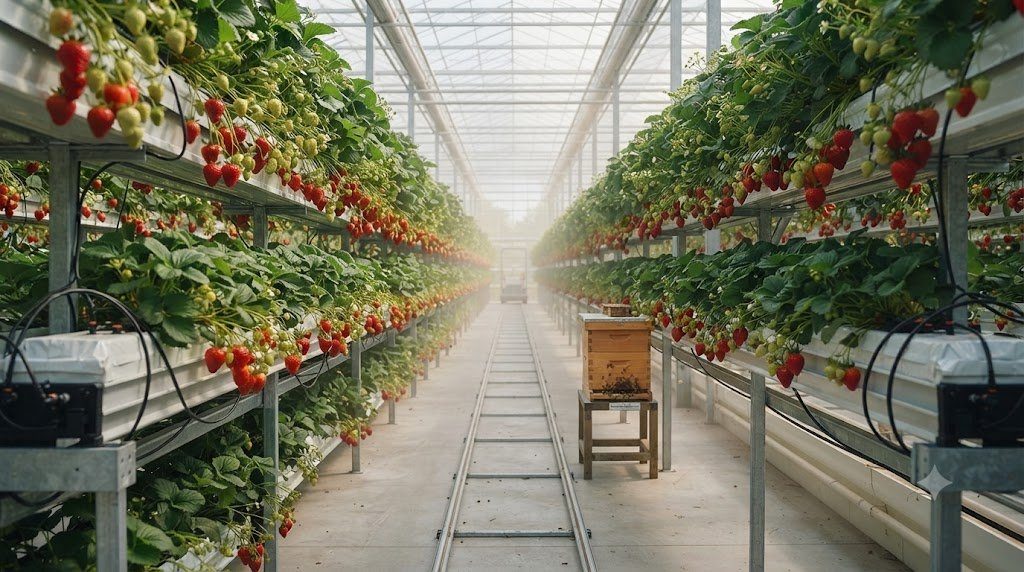
Ergonomic Waist-Height Benching: Extruded galvanized steel or food-grade polypropylene gutters are suspended from structural roof trusses or mounted on steel posts at a working height of 1.2 to 1.5 meters above the concrete floor. Workers harvest, prune, and inspect fruit standing comfortably upright, increasing labor picking velocity by 250% to 300% compared to field picking while completely eliminating back injuries.
Swing-Gutter Dynamic Density Systems: In stationary gutter layouts, walking aisles between rows must remain 80 cm wide, limiting planting density to 6 to 8 plants per square meter. Cutting-edge facilities install Motorized Swing-Gutter Systems: the gutters hang from overhead pivot cables. By rotating gutters laterally, workers open an aisle only where they are actively picking, allowing the rest of the facility to pack gutters tightly together. Swing-gutters elevate commercial planting density to an astounding 12 to 16 plants per square meter, doubling harvest volume per square meter of expensive greenhouse real estate!
3. Crown Temperature Dynamics and Chilling Requirement Physics
The botanical heart of the strawberry plant is the Crown—the compressed, modified stem situated at the soil line from which all leaves, flowering trusses, runners, and root nodes emerge:
The Summer Crown Heating Hazard: If root-zone and crown temperatures exceed 25°C (77°F), day-neutral strawberries suffer catastrophic physiological collapse: flower buds abort, fruit turns soft and flavorless, and the plant reverts to producing vegetative runners. Commercial tabletop gutters incorporate integrated Crown Cooling Loops: micro-bore polyethylene pipes circulating chilled water (14°C to 16°C) are nestled directly against the growing substrate beneath the crowns, keeping the crown microclimate cool and generative even during blistering 35°C outdoor summer conditions.
Winter Chilling Hour Requirements: Strawberry crowns possess an evolutionary requirement for Winter Chilling Hours (accumulated hours between 0°C and 7°C) to break dormancy and stimulate vigorous floral emergence. Commercial growers plant specialized Frigo Plants (cold-stored bare-root crowns) or tray plants that have received 200 to 400 certified chilling hours in commercial refrigeration coolers prior to greenhouse planting, ensuring explosive vegetative and floral vigor upon transplanting.
🍓 Commercial Substrate Physics: Coir vs. Peat in Berry Gutters
Strawberries possess ultra-delicate fibrous root systems that are acutely sensitive to over-watering and salt accumulation. The commercial standard is a 70/30 blend of washed, calcium-buffered coconut coir and coarse perlite (EC < 0.8 mS/cm). Never plant strawberries into heavy, un-aerated peat: root-zone AFP must remain above 20% to prevent Phytophthora cactorum (crown rot).
4. Pollination Mechanics: Bumblebees vs. Misshapen Fruit Prevention
A single strawberry flower contains between 200 and 500 individual pistils (stigmas), each leading to an individual ovule that must be fertilized to produce an achene (the true seed on the fruit exterior). The red fleshy fruit that consumers eat is actually an enlarged receptacle. If a cluster of stigmas fails to receive pollen, the receptacle tissue beneath those unfertilized ovules fails to expand, resulting in stunted, creased, misshapen fruit known commercially as ‘Cat-Facing’ or Culls.
The Precision Bumblebee Solution: Commercial berry greenhouses introduce miniature hives of commercial bumblebees (Bombus impatiens). Bumblebees crawl systematically across the dome of the strawberry flower, transferring pollen uniformly across all 400 stigmas in a single visit. Scout audits require that 100% of flowers receive at least 2 to 3 bee visits during opening, guaranteeing perfectly symmetrical, conical dessert berries commanding premium supermarket pricing.
5. Runner Pruning, Truss Support Tape, and Canopy Maintenance
Managing the architectural canopy of tabletop strawberries requires weekly physical crop labor:
- Runner (Stolon) Pruning: Day-neutral strawberries continuously attempt to send out horizontal runners (stolons) to propagate vegetatively. Every runner is snapped out cleanly at the crown joint each week. Permitting runners to grow siphons away valuable sugars, reducing fruit size by up to 25%.
- Truss Support Tape (Truss Racks): Tabletop gutters are fitted with flexible plastic edge ribbons or wire support grids. As heavy fruit clusters emerge, flower stems (peduncles) drape over the gutter edge. The support tape prevents the stem from kinking or creasing under fruit weight, preserving vascular xylem flow and preventing premature fruit shriveling.
- Old Leaf Sanitation: Senescing lower leaves are stripped away to maintain 6 to 8 active, healthy trifoliate leaves per crown, maximizing light penetration to ripening berries while eliminating gray mold (Botrytis) habitat.
6. Brix Sugar Accumulation and Post-Harvest Rapid Pre-Cooling
The consumer market value of dessert strawberries is dictated entirely by Brix Sugar Content and Aromatic Volatiles. While field commodity strawberries average an acidic 6.5° to 7.5° Brix, high-tech greenhouse strawberries achieve exceptional sweetness ratings of 10.0° to 12.5° Brix.
The Forced-Air Pre-Cooling Mandate: Strawberries are harvested at 90% to 95% full red maturity directly into consumer clamshell packages (eliminating human touching of delicate fruit flesh). Within 60 minutes of picking, harvested berry pallets are placed into industrial Forced-Air Cooling Tunnels. High-velocity chilled air (1.0°C / 34°F) is pulled through the clamshell vent holes, stripping field heat and reducing core fruit temperature from 22°C down to 2.0°C in under 90 minutes. Rapid pre-cooling halts respiration, preserves natural fruit firmness, and extends retail supermarket freshness to 14 to 18 days.
7. Low-EC Fertigation Chemistry for Salt-Sensitive Berry Roots
Strawberry roots are among the most salt-sensitive crops in commercial horticulture. Supplying fertilizer solutions with excessive electrical conductivity causes immediate osmotic root burn and foliar edge necrosis:
- Target Feed EC: Commercial strawberry feed is maintained at an ultra-low EC of 1.2 to 1.6 mS/cm, with slab drain EC not exceeding 1.8 mS/cm.
- Target Solution pH: Solution pH is calibrated tightly to 5.6 to 6.0. Strawberries have an exceptionally high demand for bio-available iron (Fe) and manganese (Mn); if pH drifts above 6.2, severe interveinal chlorosis develops across expanding leaves within days.
8. Supplemental LED Lighting and Daily Light Integral (DLI) Targets
To sustain commercial strawberry harvesting throughout dark winter months, greenhouse facilities deploy overhead supplemental LED lighting. Strawberries exhibit a light saturation threshold between 350 and 450 µmol/m²/s PPFD, with optimal biomass accumulation occurring at a target Daily Light Integral (DLI) of 17 to 22 mol/m²/day.
Supplying supplemental light with an enriched red-to-far-red spectrum accelerates flower stem elongation, pushing flower clusters out past the foliage canopy where they receive maximum light and bee visitation. Furthermore, maintaining an 18-hour photoperiod with energy-efficient LEDs keeps vegetative crowns actively initiating new flower buds, completely eliminating winter production voids.
9. Powdery Mildew and Two-Spotted Spider Mite IPM in Tabletop Systems
Because strawberries are harvested continuously for direct fresh consumption, chemical synthetic pesticide residues are strictly prohibited by commercial supermarket buyers. Pest management relies entirely on Biological Integrated Pest Management (IPM):
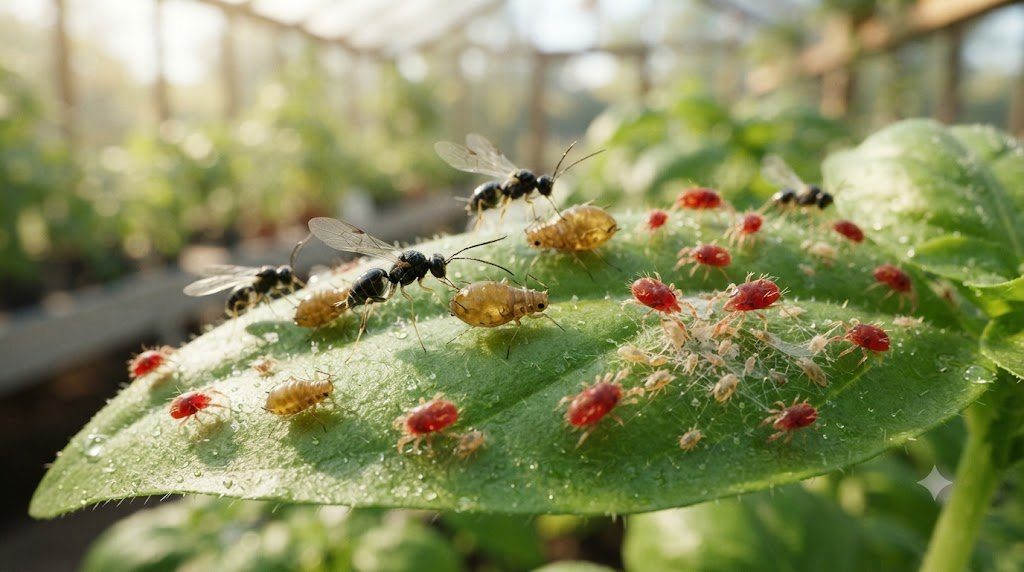
- Two-Spotted Spider Mite (Tetranychus urticae): Managed via preventative releases of predatory mites (Phytoseiulus persimilis and Neoseiulus californicus) at a rate of 5 to 10 predators per square meter bi-weekly.
- Powdery Mildew (Podosphaera aphanis): Controlled via nightly ultra-low-dose UV-C robotic treatments (delivering 200 J/m² of 254 nm light to DNA-damage mildew conidia without harming plants) and preventative bio-fungicide sprays of Bacillus amyloliquefaciens.
10. Commercial Yield Economics and 10-Year Tabletop ROI
While tabletop gutter systems require an initial capital investment of $30 to $45 per square meter (including gutters, drip lines, and swing cables), the commercial unit economics are extraordinary. High-tech facilities achieve marketable yields of 12 to 16 kg/m² annually, commanding wholesale premium winter pricing of $6.00 to $9.00 per kilogram.
Gross annual revenues reach $90 to $140 per square meter. When coupled with 60% lower harvest labor costs, 90% water savings, and zero chemical fumigation expenses, commercial tabletop strawberry installations deliver full capital payback within 2.5 to 3.2 operating seasons, representing one of the highest-growth segments in global CEA investment.
11. Microclimate Humidity and Vapor Pressure Deficit Steering in Strawberries
Controlled environment strawberry canopies possess delicate foliar cuticles that require disciplined VPD steering across each phase of the diurnal cycle:
1. Daytime Transpiration Envelope: Commercial agronomists target a daytime Leaf VPD corridor of 0.8 to 1.1 kPa. If VPD spikes above 1.3 kPa, strawberry stomata snap shut to conserve moisture, halting CO₂ assimilation and inducing calcium deficiency at rapidly expanding leaf tips (manifesting as foliar tip-burn). Conversely, if daytime VPD drops below 0.5 kPa, transpiration halts, cutting off calcium flow to developing calyxes.
2. Nighttime Relative Humidity Management: Nighttime relative humidity must be maintained at 75% to 82% (VPD 0.3 to 0.5 kPa). This moderate vapor deficit generates mild, controlled root pressure that gently translocates calcium to non-transpiring embryonic flower meristems, without crossing the condensation dew point that triggers fungal germination of Botrytis cinerea or anthracnose.
12. Strawberry Tray Plant Propagation and Cold Dormancy Vernalization
The success of a high-yielding greenhouse strawberry cycle is determined months before greenhouse planting during the specialized nursery propagation phase:
1. Tray Plant vs. Frigo Plant Architecture: While traditional soil growers utilize bare-root ‘frigo’ runners dug from open nursery fields, high-tech glasshouse growers utilize Plug / Tray Plants. Runners are rooted into 250 cc peat-coir plug trays under mist benches in specialized propagation nurseries during late summer. These plants develop dense, intact root plugs and large crown calipers (exceeding 14 to 18 mm).
2. Controlled Cold Storage Vernalization: Once crowns initiate floral initials in early autumn, tray plants are transferred to climate-controlled dark refrigeration facilities held at -1.5°C to -2.0°C (28°F to 29°F). Accumulating 300 to 500 hours of artificial dormancy chilling satisfies the plant’s evolutionary chilling requirement. When planted into the greenhouse under warm, lit conditions, these vernalized tray plants burst into immediate, vigorous vegetative growth and produce harvestable dessert berries within 60 days of transplanting.
13. Carbon Dioxide Enrichment and Tabletop Photosynthetic Fixation
In tightly sealed commercial strawberry glasshouses, photosynthetic carbon fixation by dense foliar canopies depletes ambient CO₂ rapidly during morning hours, dropping concentrations below 300 ppm if unmanaged:
1. Atmospheric CO₂ Dosing Strategies: High-performance CEA facilities introduce liquid pure CO₂ or boiler flue gas dosing (after catalytic cleaning) to elevate canopy CO₂ concentrations to 800 to 1,000 ppm during daylight periods when roof vents remain closed. Elevated CO₂ suppresses photorespiration in C3 strawberry plants, increasing net carbon assimilation by 28% to 35%.
2. Brix Sugar Elevation: The primary commercial benefit of CO₂ enrichment in dessert strawberries is enhanced hexose sugar accumulation. Elevated atmospheric carbon availability accelerates sucrose synthesis in source leaves, driving intense sugar translocation into developing berry receptacles. Crops grown under optimized 900 ppm CO₂ consistently register an extra 1.5° to 2.0° Brix compared to non-enriched greenhouse environments, delivering the rich, lingering sweetness prized by premium retail grocers.