❄️ Thermodynamic Cooling & Psychrometric Engineering: Commercial Greenhouses
A rigorous comparative thermodynamic analysis of commercial evaporative greenhouse cooling technologies. We evaluate wet-bulb depression physics, pad saturation efficiency coefficients, static airflow pressure drop, high-pressure fogging atomization physics, water quality reverse osmosis requirements, and 10-year life-cycle operational economics.
In hot arid and semi-arid agricultural regions (such as the Southwestern United States, Southern Europe, the Middle East, and Northern Australia), summer solar irradiance routinely generates interior thermal loads exceeding 600 to 800 Watts per square meter. Without active mechanical cooling, an enclosed greenhouse transforms into a solar thermal trap, with interior air temperatures soaring past 45°C (113°F). At these extreme temperatures, photosynthetic enzymes denature, pollen becomes sterile, and valuable commercial crops suffer fatal thermal collapse.
Because traditional compressor-driven air conditioning (HVAC) is financially cost-prohibitive across multi-hectare agricultural facilities due to astronomical electrical power consumption, commercial Controlled Environment Agriculture relies almost exclusively on Evaporative Cooling Thermodynamics. The two predominant industrial technologies deployed globally are the Evaporative Pad-and-Fan System and the High-Pressure Fogging System (HPFS). In this engineering monograph, we conduct a rigorous comparative analysis of both platforms across fluid mechanics, psychrometric performance, microclimatic uniformity, water quality engineering, and total life-cycle economics.
1. The Thermodynamic Principle of Evaporative Cooling
Both pad-and-fan and high-pressure fogging systems operate on the fundamental thermodynamic principle of adiabatic cooling (constant enthalpy heat exchange). When liquid water evaporates into unsaturated air, it requires thermal energy to overcome intermolecular hydrogen bonds and transition into a gaseous vapor state. This energy—termed the Latent Heat of Vaporization—equals approximately 2,454 kiloJoules per kilogram of evaporated water at standard ambient greenhouse temperatures.
Because no external thermal energy is added to or removed from the greenhouse air mass during this rapid phase change, the sensible heat of the air (the kinetic energy measured by a standard dry-bulb thermometer) is converted directly into latent heat (the energy stored within the molecular bonds of water vapor). As a consequence, the dry-bulb temperature of the air drops while the absolute and relative humidity increases, traveling diagonally downward along the line of constant enthalpy on the psychrometric chart toward the saturation curve.
The absolute theoretical thermodynamic limit of any evaporative cooling system is the outdoor Wet-Bulb Temperature (T_wb). The difference between the ambient dry-bulb temperature and the wet-bulb temperature is known as the Wet-Bulb Depression:
Wet-Bulb Depression = T_dry-bulb – T_wet-bulb
In dry desert regions where outdoor air is 38°C (100°F) with 15% relative humidity, the wet-bulb temperature is approximately 20°C (68°F), providing a massive 18°C wet-bulb depression. In humid tropical regions where outdoor air is 32°C with 80% relative humidity, the wet-bulb depression is only 3°C, rendering evaporative cooling technologies largely ineffective without auxiliary mechanical dehumidification.
2. Evaporative Pad-and-Fan Systems: Architecture and Fluid Dynamics
The evaporative pad-and-fan system has been the global workhorse of commercial greenhouse cooling for more than half a century. Its architectural layout is straightforward yet mechanically rigorous:
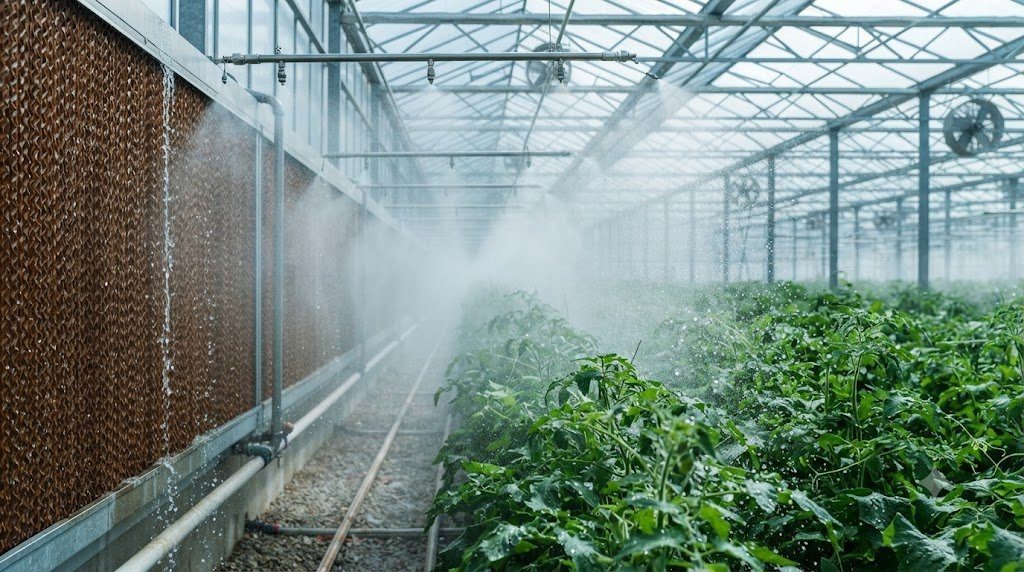
System Architecture: The entire length of one exterior greenhouse wall (typically the windward wall) is fitted with continuous vertical banks of fluted cellulose or plastic evaporative pads (typically 100 mm or 150 mm thick). An overhead distribution pipe with calibrated metering orifices pumps water continuously over the top of the pads, keeping them uniformly soaked. Excess water drains into a subterranean return gutter and recirculates back to a sump tank. On the opposing wall (or roof ridge), massive motorized direct-drive exhaust fans (typically 1.2 to 1.5 meters diameter) pull enormous volumes of air out of the greenhouse, creating a slight negative static pressure inside that draws fresh outdoor air through the saturated wet pads.
Evaporative Saturation Efficiency (η): The cooling capability of an evaporative pad is governed by its saturation efficiency coefficient:
η_pad = (T_air,inlet – T_air,exit) / (T_air,inlet – T_wet-bulb)
High-grade 150-mm cross-fluted cellulose pads (featuring 45° × 15° flute angles) operating at an optimal face velocity of 1.2 to 1.5 meters per second achieve saturation efficiencies of 80% to 88%. If the face velocity is too slow (< 0.7 m/s), capital costs are squandered; if too fast (> 1.8 m/s), air tears water droplets off the pad face (carryover), flooding walkways while static pressure drop surges dramatically, overloading exhaust fan motors.
| Engineering Metric | Evaporative Pad-and-Fan Matrix | High-Pressure Fogging System (HPFS) | Agronomic & Operational Comparison |
|---|---|---|---|
| Thermodynamic Saturation Efficiency | 80% – 88% (at pad face) | 90% – 95% (distributed in-situ) | Fogging delivers higher theoretical cooling potential |
| Spatial Temperature Gradient | Severe (3°C – 7°C rise across bay) | Virtually Zero (Uniform ± 1°C) | Pad systems create hot zones near exhaust fans |
| Electrical Fan Power Required | High (Continuous 35 – 55 W/m²) | Low (Relies on natural roof vents) | Fogging slashes electrical fan consumption by 60% |
| Operating Water Pressure | Low Pressure (1.0 – 2.0 bar) | Extreme High Pressure (70 – 100 bar) | Fog requires heavy stainless steel piping & seals |
| Water Purity Requirement | Moderate (EC < 1.2 mS/cm) | Extreme (Demineralized RO water, EC < 0.05) | Fog nozzles clog instantly without high-grade RO |
| Suitability for Large Multi-Span | Poor (Max distance 40 – 60 meters) | Exceptional (Scalable across 10+ hectares) | Pad systems cannot cool spans exceeding 60 meters |
3. The Spatial Temperature Gradient Vulnerability of Pad Systems
The single greatest operational and agronomic limitation of the pad-and-fan configuration is the longitudinal temperature gradient that inherently develops across the greenhouse floor. Air enters the pad wall at its coolest temperature. However, as this cooled air travels 40 to 60 meters across the crop canopy toward the exhaust fans, it continuously absorbs solar thermal radiation entering through the roof glazing, as well as sensible heat emitted by crops and equipment.
In commercial facilities with 50-meter spans, the air temperature rises by 0.1°C to 0.15°C per linear meter of travel. Consequently, crops located immediately adjacent to the wet pads experience refreshing 21°C air, while crops situated near the exhaust fans 50 meters away swelter in 28°C to 30°C conditions! This 7°C to 9°C temperature differential creates severe agronomic chaos:
- Uneven Crop Maturation: Plants in hot zones transpire faster, demand higher irrigation volumes, mature earlier, and exhibit smaller fruit size compared to slow-growing plants near the cool pad wall.
- VPD Stratification: VPD shifts from 0.6 kPa near the pads to over 1.8 kPa near the fans, making automated fertigation and IPM pest management extremely challenging across a single production zone.
📏 Mechanical Design Limit: Maximum Airflow Distance
Agricultural engineering standards (ASAE EP406.4) strictly limit the maximum distance between evaporative pads and exhaust fans to 45 to 60 meters (150 to 200 feet). Designing spans longer than 60 meters requires installing intermediate misting booster lines or roof-mounted exhaust fans to prevent air temperatures from rising past lethal crop thresholds before reaching exhaust points.
4. High-Pressure Fogging: Atomization Thermodynamics and In-Situ Evaporation
High-Pressure Fogging Systems (HPFS) overcome the spatial limitations of pad-and-fan installations by distributing evaporative cooling uniformly throughout the entire interior greenhouse volume, completely eliminating longitudinal microclimatic gradients.
Atomization Physics: High-pressure industrial plunger pumps pressurize demineralized water to 70 to 100 bar (1,000 to 1,450 PSI), pumping it through an overhead grid of seamless 316 stainless steel tubes suspended above crop canopies. Specialized anti-drip impingement or swirl-core nozzles (with microscopic ruby or stainless orifices measuring 0.15 to 0.20 mm) shear the high-velocity liquid jet into billions of atomized micro-droplets with an average Sauter Mean Diameter (SMD) of 8 to 12 microns.
Aerodynamic Evaporative Mechanics: Because an 8-micron droplet has an immense surface-area-to-mass ratio, its terminal settling velocity in air is less than 2 millimeters per second. The droplet evaporates completely into the surrounding air within 3 to 6 seconds, extracting thermal energy right at the crop canopy level without ever falling to the floor or wetting foliage. When integrated with natural roof ridge ventilation, the cooled buoyant air circulates naturally, maintaining temperatures uniform to within ± 1.0°C across facilities spanning 10 hectares or more.
5. Water Quality Engineering: Reverse Osmosis vs Mineral Scaling
Water quality constitutes the critical life-or-death engineering factor determining whether an evaporative cooling investment succeeds or fails catastrophically:
1. Pad-and-Fan Mineral Scaling Dynamics: Because pad systems continuously recirculate water through an open sump, pure water evaporates while dissolved minerals (calcium, magnesium, carbonates, silica) remain behind. The electrical conductivity (EC) of the sump water rises rapidly. If left unmanaged, calcium carbonate (CaCO₃) scale precipitates across pad flutes, clogging air channels, doubling static airflow resistance, and starving exhaust fans. Operators must install automated bleed-off valves that continuously discharge 10% to 20% of recirculating water to drain, maintaining sump water EC below 1.2 mS/cm.
2. Fogging Demineralization via Reverse Osmosis (RO): In high-pressure fogging, water recirculation is physically impossible; all pumped water is atomized into the air. If raw well water containing dissolved minerals is fed to high-pressure fog nozzles, two catastrophic failures occur instantly:
- Instantaneous Nozzle Clogging: Microscopic 0.15 mm ruby orifices clog with mineral scale within hours of operation.
- The ‘White Powder’ Crop Hazard: When mineral-laden water droplets evaporate in mid-air, the dissolved calcium and silica do not vanish; they precipitate as microscopic airborne chalk dust. This white mineral dust settles over crop foliage and fruit, clogging leaf stomata, diminishing photosynthetic light capture by 15%, and leaving unmarketable chalk stains on tomatoes and cucumbers that cannot be washed off.
Consequently, high-pressure fogging systems mandate a dedicated Reverse Osmosis (RO) water purification plant equipped with multi-media pre-filtration, water softeners, and post-RO ultraviolet sterilization. Fog feed water must be purified to an electrical conductivity EC < 0.05 mS/cm (Total Dissolved Solids < 25 ppm) to ensure indefinite nozzle lifespan and immaculate crop foliage.
6. Fan Aerodynamics and Static Pressure Drop Calculations
In pad-and-fan installations, the electrical operating cost is dictated by the total airflow volume and the static pressure resistance of the building envelope:
Total Airflow Requirement (m³/h) = Floor Area (m²) × Canopy Height (m) × 45 to 60 Air Exchanges per Hour
For a 10,000 m² (1 hectare) greenhouse with a 5-meter gutter height, the ventilation system must move over 300,000 cubic meters of air per hour. As this massive air volume is pulled through wet evaporative pads, structural insect exclusion screens, and dense plant canopies, it encounters severe aerodynamic resistance. A clean, wet 150-mm cellulose pad creates a static pressure drop of 25 to 35 Pascals (Pa). When paired with high-mesh insect screens (50-mesh thrips netting creates 40 to 60 Pa drop), the total static pressure resistance exceeds 75 to 100 Pascals.
Exhaust fan airflow output drops precipitously as static pressure rises. Engineers must select heavy-duty, direct-drive exhaust fans equipped with aerodynamic discharge cones and certified AMCA ratings, engineered to deliver full volumetric flow against 100 Pa of resistance without motor overheating.
7. Electrical Energy Consumption and Operational Economics
Conducting a rigorous financial lifecycle analysis reveals a stark contrast between capital costs (Capex) and electrical operational expenses (Opex) for the two technologies:
- Capital Expenditure (Capex): A complete pad-and-fan installation (including cellulose pads, distribution plumbing, sumps, and exhaust fans) costs approximately $14 to $22 per square meter. A high-pressure fogging system (including 100-bar stainless pumping stations, ruby nozzles, stainless distribution lines, and a commercial Reverse Osmosis water plant) costs $28 to $42 per square meter—representing an initial capital premium of nearly 100%.
- Electrical Operating Costs (Opex): The operational financial equation reverses dramatically over time. A 1-hectare pad-and-fan facility requires twenty-five 1.5 kW exhaust fans running continuously during hot daylight hours, drawing over 37.5 kW of continuous electrical power. In contrast, a high-pressure fogging system operates with natural roof ridge vents, requiring only a single 7.5 kW high-pressure pump motor pulsing intermittently (50% duty cycle), consuming an average of just 3.75 kW—a 90% reduction in electrical power consumption!
In regions where agricultural electricity tariffs exceed $0.15 per kilowatt-hour, the electrical savings generated by high-pressure fogging offset the higher initial capital expenditure within 3.5 to 4.5 operating seasons, while delivering superior crop uniformity and yield.
8. Maintenance Protocols and Algae Prevention in Evaporative Pads
Maintaining biological hygiene in evaporative cooling pads requires rigorous preventative maintenance. Constantly wet cellulose pads exposed to sunlight provide an ideal growth habitat for green algae, bacterial slimes, and fungal pathogens. Heavy algal growth mats across pad faces, choking airflow and emitting foul odors.
Pad Sanitation Best Practices:
- Complete Nightly Dry-Out: The climate automation computer must shut down pad circulating pumps at least 2 hours before exhaust fans cycle off each evening, allowing the pads to dry out completely overnight. Complete diurnal desiccation kills algal filaments before thick mats can establish.
- Chemical Biocide Dosing: Operators should shock-dose sump tanks weekly with specialized non-foaming quaternary ammonium compounds or low-concentration hydrogen peroxide (50 to 100 ppm active H₂O₂). Never use chlorine bleach (sodium hypochlorite) on cellulose pads; free chlorine attacks the phenolic resin binders within cellulose fibers, causing pads to disintegrate into structural mush within a single season.