☀️ Thermodynamic Agricultural Engineering: Passive Solar Greenhouses
A comprehensive engineering treatise detailing the thermodynamics and architectural physics of passive solar greenhouses. We analyze the Chinese solar lean-to design, solar azimuth and roof angle optimization, sensible vs. latent thermal mass calculations, subterranean Ground-to-Air Heat Exchangers (GAHT), and automated night insulating blankets.
For commercial and decentralized horticultural producers in cold northern climates (USDA Plant Hardiness Zones 3 through 6), conventional greenhouse production is severely constrained by heating energy costs. Traditional four-sided glass or poly greenhouses lose staggering quantities of thermal energy through uninsulated northern, eastern, and western glazed walls during winter months. When fossil fuel heating costs (natural gas, propane, heating oil) spike, heating expenses frequently consume 25% to 40% of total operational revenues, rendering mid-winter vegetable production financially insolvent.
Passive Solar Greenhouse Engineering—derived from decades of empirical agricultural optimization in northern China and modern bioclimatic architecture in North America—completely revolutionizes cold-climate horticulture. By replacing non-productive glazed surfaces with highly insulated, thermal-mass-dense structural envelopes, optimizing southern glazing angles for winter solar declination, and integrating subterranean ground-to-air heat exchangers (GAHT), passive solar greenhouses maintain interior temperatures above freezing throughout brutal sub-zero winters with zero fossil fuel consumption.
1. Architectural Anatomy of the Chinese Solar Lean-To (CSG)
The global benchmark for zero-heating passive solar production is the Chinese Solar Greenhouse (CSG), which currently spans over 800,000 hectares across northern China, supporting year-round commercial tomato, pepper, and cucumber production in regions with winter lows dropping to -20°C (-4°F):
1. Strict East-West Axis Orientation: The greenhouse is oriented precisely along an East-West longitudinal axis, with the primary glazed surface facing true geographic South (or 5° to 8° West of South to capture afternoon thermal gains). This orientation ensures the maximum possible surface area intercepts low-angle winter sunlight.
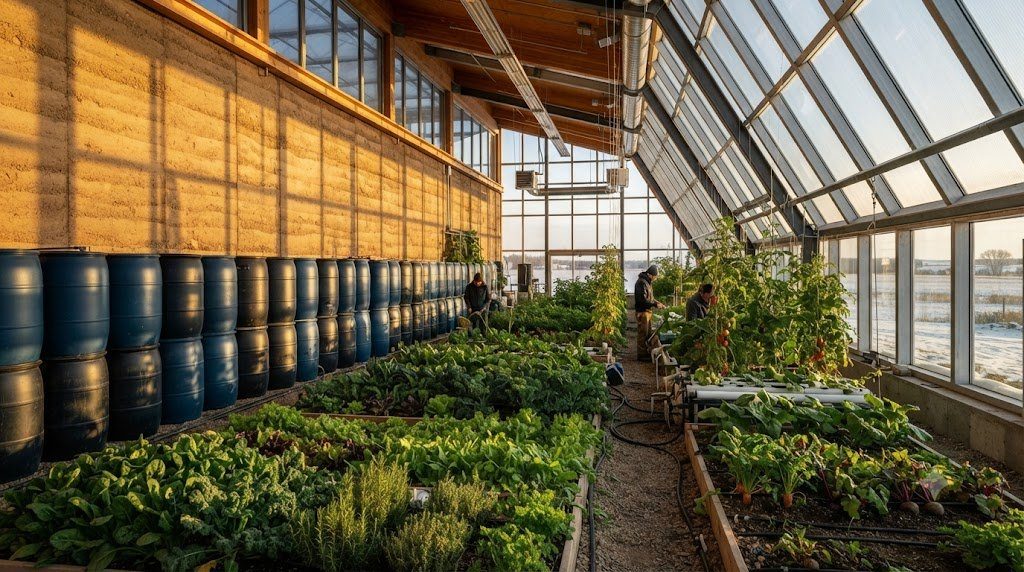
2. The Super-Insulated Northern Rear Wall: Unlike Western greenhouses that glaze all four walls, a passive solar greenhouse glazes only the southern roof. The northern wall, eastern end-wall, and western end-wall are constructed as thick, highly insulated structural barriers. The northern rear wall serves a dual physical function: (a) structural roof support, and (b) thermal heat absorption and nocturnal re-radiation.
3. Southern Glazing Angle Optimization: In cold climates, the sun sits low on the horizon during the winter solstice. If a southern roof pitch is too flat, low-angle winter sunlight bounces off the glazing as specular reflection rather than penetrating inside. The optimum southern roof angle (θ) is calculated using the winter solstice solar altitude equation:
Optimal Glazing Angle (θ) = Local Latitude + 15° to 20° (Ensuring incident angle < 30° at noon on Dec 21)
For example, at 42° North Latitude, the southern curved glazing enters the ground at a steep 60° to 65° angle before sweeping upward to a 35° apex pitch, ensuring low-angle winter solar rays strike the glazing almost perpendicular (maximizing solar energy transmission to > 88%).
| Component Architecture | Standard Western Polyhouse | Passive Solar Lean-To (CSG) | Thermal & Horticultural Advantage |
|---|---|---|---|
| Glazing Orientation | 360° All Sides Glazed | South Face Glazed Only; North Solid | Eliminates 65% of nighttime radiative surface area |
| North Wall Construction | Single / Double Poly (R-1.5) | Earth Berm / Insulated Mass (R-25 to R-35) | Acts as permanent heat battery and wind barrier |
| Thermal Storage Integration | Zero (Relies on active gas heaters) | Water Barrels, Rammed Earth, PCM, GAHT | Captures surplus daytime BTUs for nighttime release |
| Nighttime Thermal Insulation | None (or thin ceiling screen) | Automated 5-cm Multilayer Thermal Blanket | Provides R-8 to R-12 insulated roof closure at night |
| Minimum Winter Temp without Heat | Drops to outside ambient (-15°C / 5°F) | Maintains +8°C to +12°C (46°F – 54°F) | Enables continuous winter harvest of cold-hardy crops |
2. Thermal Mass Thermodynamics: Sensible vs. Latent Heat Storage
During a clear winter day, incoming solar radiation inside a sealed passive solar greenhouse generates immense surplus thermal energy. Interior air temperatures can surge past 32°C (90°F) in January even when outdoor temperatures are -10°C (14°F). In a conventional greenhouse, this valuable heat is vented outside through exhaust fans to prevent crop heat stress, and then fossil fuel heaters are fired hours later when night falls.
In a passive solar facility, this surplus daytime thermal energy is actively captured by Thermal Mass Storage Systems:
1. Sensible Heat Storage (Water and Rammed Earth): Sensible thermal storage materials absorb heat by increasing their physical temperature:
- Water Thermal Mass: Water possesses the highest specific heat capacity of any common non-hazardous material: 4.184 Joules per gram per Kelvin (1.0 BTU/lb/°F). Stacking black 200-liter (55-gallon) water drums along the interior northern wall creates an extraordinary heat sink. Black barrels absorb shortwave solar radiation during midday, heating to 28°C to 35°C. At night, as interior air cools, the barrels re-radiate longwave thermal infrared heat into the plant canopy. Rule of thumb: install 80 to 120 liters of water storage per square meter of greenhouse floor area.
- Rammed Earth and Concrete: High-density poured concrete, adobe, or compacted soil walls (specific heat capacity ~0.84 J/g·K) provide massive structural thermal inertia. While slower to absorb heat than water, a 40-cm thick masonry rear wall buffers temperatures across 48 to 72 hour cloudy stretches.
2. Latent Heat Storage (Phase Change Materials – PCM): Advanced passive solar engineering incorporates Phase Change Materials (PCMs), such as inorganic hydrated salt solutions (calcium chloride hexahydrate) or bio-based paraffins engineered to melt and solidify at precisely 18°C to 22°C (64°F to 72°F). As interior temperatures rise during the day, the PCM melts, absorbing immense latent heat of fusion without getting hotter. At night, as temperatures drop, the PCM solidifies, releasing that stored latent heat back into the greenhouse. PCMs store 300% to 500% more thermal energy per unit volume than water, saving valuable floor space.
⚡ Thermodynamic Rule: Thermal Mass Surface Area vs Volume
A common design mistake is utilizing massive water storage tanks with low surface area. Heat transfer between water and greenhouse air is strictly governed by convection surface area! Ten 200-liter drums absorb and release heat three times faster than a single 2,000-liter tank of identical volume. Always maximize the exposed surface area of thermal storage elements facing direct sunlight.
3. Subterranean Ground-to-Air Heat Exchangers (GAHT)
While surface water barrels buffer nighttime air temperatures, the most powerful seasonal energy storage technology in modern passive design is the Subterranean Ground-to-Air Heat Exchanger (GAHT), commonly referred to as an ‘Earth Battery’ or Climate Battery:
Engineering Architecture: Prior to building construction, an excavation 1.5 to 2.5 meters deep is completed across the greenhouse footprint. Perforated, smooth-interior corrugated polyethylene (HDPE) drainage pipes (typically 100 to 150 mm diameter) are laid in two or three horizontal tiers spaced 40 to 60 cm apart within crushed aggregate or native soil, connected to supply and return manifold headers.
Diurnal and Seasonal Operating Cycle:
- Daytime Heat Injection: When the greenhouse apex reaches 24°C (75°F), automated thermostat fans draw hot, humid air from the top of the greenhouse down into the manifold. As the warm air passes through the subterranean pipes, heat conducts into the cooler surrounding soil mass (soil temperature typically 12°C to 15°C). Water vapor in the warm air condenses on the pipe walls, releasing valuable latent heat of condensation into the subsoil while naturally dehumidifying the greenhouse air!
- Nighttime Heat Extraction: At night, as the greenhouse air drops below 12°C (54°F), the fans reverse or cycle on low speed. Cool greenhouse air is pumped through the subterranean network, absorbing the stored heat from the soil battery and exhausting warm 15°C air back into the crop canopy.
A properly engineered GAHT system stores enough thermal energy within the 2-meter soil bed beneath the greenhouse to elevate night root-zone temperatures by 6°C to 10°C throughout sub-zero winter periods, keeping plant roots actively uptaking water and nutrients with negligible electrical fan power (less than 150 Watts per 100 m²).
4. Automated Insulating Night Blankets and R-Value Physics
The final pillar of passive solar design is the Automated Exterior Insulating Blanket. During sunny winter days, transparent glazing must remain exposed to harvest solar photons. However, once the sun sets, uninsulated glazing becomes an intense radiator of heat into the black night sky.
At dusk, an automated electric geared motor rolls an exterior multi-layer insulating blanket down over the entire southern glazed roof. Modern thermal blankets feature a 5-layer composite architecture: outer UV-resistant waterproof woven fabric, interior layers of needle-punched wool/polyester insulation, and reflective aluminum foil vapor barriers, achieving an insulation rating of R-8 to R-12 (U-value < 0.6 W/m²·K). With the thermal blanket deployed, the passive solar greenhouse transforms into an enclosed, insulated cooler box, locking in daytime thermal reserves until sunrise.
7. Retrofitting Existing Polyhouses for Passive Solar Storage
Commercial growers operating existing north-facing gutter-connected polyhouses can systematically retrofit their facilities to capture passive solar benefits without rebuilding structural steel frames:
1. Interior North Wall Insulated Curtain Installation: Install a permanent vertical insulation curtain along the interior northern wall. Utilizing closed-cell foam board or multi-foil bubble insulation (achieving R-6 to R-10) isolates the un-illuminated north exposure, cutting nighttime building heat loss by 25% to 35% with zero impact on incoming southern photosynthetic light.
2. Water Barrel Boundary Walls: Position high-density polyethylene 200-liter black drums filled with water against north wall interior posts. In addition to acting as radiant heat batteries, stacking drums creates an effective thermal buffer that stabilizes root-zone temperatures in adjacent crop benches.
3. Perimeter Ground Insulation: Excavate a shallow trench (45 to 60 cm deep) around the exterior foundation perimeter and install 5 cm thick extruded polystyrene (XPS) rigid foam boards (R-10). Perimeter insulation prevents frozen outdoor subsoils from wicking heat horizontally out of the greenhouse floor bed, maintaining root-zone temperatures 4°C to 6°C warmer.
8. Thermal Destratification and Microclimatic Air Circulation
In passive solar greenhouses, thermal buoyancy causes heated air to rise rapidly toward the high roof peak, while cold, dense air settles in the plant canopy along the floor. In an unmanaged structure, a temperature gradient of 8°C to 12°C can develop between the peak and the floor, leaving plant roots shivering while valuable heat stagnates uselessly in the rafters.
Installing low-wattage Horizontal Air Flow (HAF) fans combined with vertical destratification duct tubes breaks up this stratification. Automated fans draw warm air from the roof peak and discharge it gently downward through perforated poly tubes along walking pathways. This gentle circulation (maintaining an air velocity of 0.3 to 0.5 meters per second across foliage) equalizes temperatures, eliminates cold microclimatic pockets, and continuously replenishes carbon dioxide around plant stomata without creating evaporative chilling stress.
9. Winter Humidity Management and Passive Condensation Traps
A classic challenge in tightly sealed passive solar greenhouses during deep winter is excessive relative humidity. Because nighttime air exchange is restricted to conserve precious thermal energy, water vapor transpired by active crops rapidly saturates the interior atmosphere, driving relative humidity toward 95% to 100%.
Engineering Passive Moisture Trapping: To prevent foliar moisture films and fungal sporulation without opening cold roof vents, passive solar greenhouses utilize specialized condensation collection dynamics. The sloped southern glazing naturally operates as a giant dehumidifying cold plate. Moisture condenses continuously onto the inner face of the glazing, where anti-drip surface tension additives channel the water down into sealed base gutters rather than dripping onto plants. Additionally, the subterranean GAHT system acts as an active underground dehumidifier: as warm humid air is circulated through the cooler subsoil pipes during daytime hours, moisture condenses on the pipe interior walls and drains into subterranean dry-wells, removing dozens of liters of excess atmospheric water daily while recycling latent heat directly into the floor bed.
11. Supplemental Carbon Dioxide Enrichment in Enclosed Solar Envelopes
Because passive solar greenhouses remain tightly sealed throughout sub-zero daylight hours to conserve captured solar heat, crop photosynthesis rapidly depletes interior ambient carbon dioxide levels. Ambient outdoor air contains approximately 415 ppm of CO₂. Within two hours of sunrise on a bright winter morning, a vigorous crop canopy of leafy brassicas or tomatoes can draw interior CO₂ concentrations down below 180 to 200 ppm, inducing severe photosynthetic starvation and stomatal constriction.
Passive and Low-Cost Enrichment Solutions: In high-tech facilities, liquid CO₂ tanks or natural gas burner exhausts supply pure carbon dioxide. In decentralized passive solar designs, growers successfully deploy biological enrichment systems: integrating on-site aerobic compost digestion tubes beneath growing benches or positioning vermicomposting beds along the insulated north wall. Microbial respiration within the active compost mass generates a steady continuous stream of 800 to 1,200 ppm CO₂, supercharging canopy photosynthetic assimilation by 25% to 35% while simultaneously contributing auxiliary sensible biological heat to the greenhouse airspace.