🧱 Horticultural Substrate Mechanics: Mineral & Organic Growing Media
A rigorous physical and chemical engineering treatise evaluating commercial soilless growing media in Controlled Environment Agriculture. We analyze substrate total porosity, container capacity, Air-Filled Porosity (AFP), water retention curves (pF curves), cation exchange capacity (CEC), and irrigation dry-back steering physics.
In modern soilless Controlled Environment Agriculture (CEA), the growing medium—or substrate—functions as the physical anchor for the root architecture and the mechanical reservoir for water, oxygen, and dissolved mineral nutrients. The historical practice of cultivating commercial greenhouse crops in natural field soil has been entirely abandoned due to soil-borne pathogenic nematode and fungal pressures, non-uniform soil compaction, erratic mineral salinity, and uncontrollable hydraulic drainage dynamics.
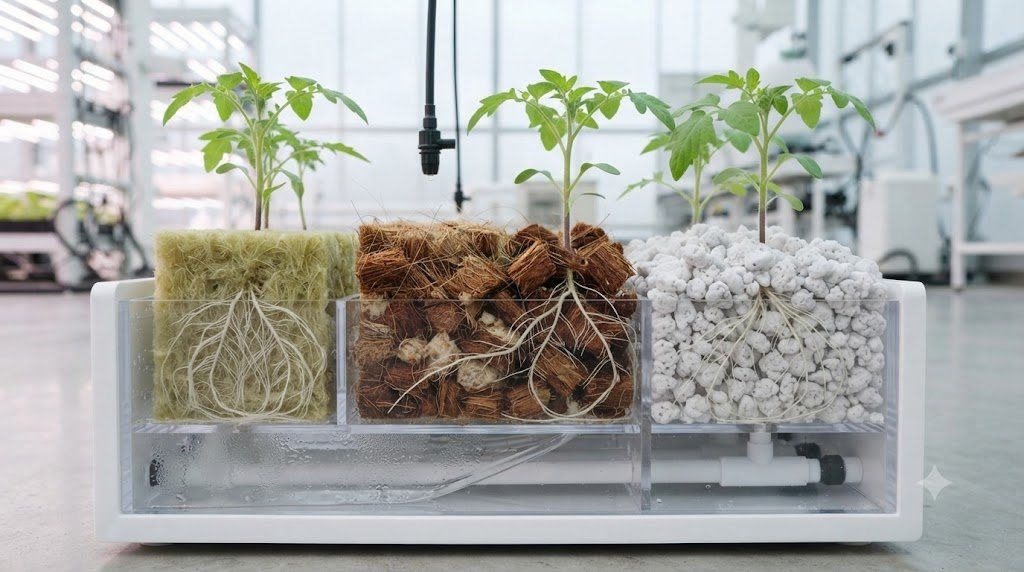
Today, commercial greenhouse agronomists select among three dominant soilless substrate platforms: engineered Horticultural Rockwool (Stone Wool), organic Coconut Coir (Coco Peat), and volcanic expanded Perlite. Each material exhibits drastically distinct pore-size distributions, hydraulic conductivity curves, chemical buffering capabilities, and root aeration mechanics. Selecting the correct substrate and calibrating irrigation dry-back strategies requires a rigorous understanding of substrate physics, unsaturated fluid flow, and root-zone gas exchange dynamics.
1. Foundational Substrate Physics: Porosity, AFP, and Container Capacity
To evaluate any soilless substrate, agricultural engineers analyze three foundational physical parameters that govern fluid and gas movement within the root zone:
1. Total Porosity (TP, % volume): The fraction of total substrate volume occupied by void space (pores) rather than solid structural fibers or particles. High-performance commercial substrates exhibit total porosities between 75% and 96%, meaning that nearly the entire slab consists of air and water holding space.
2. Container Capacity (Water-Holding Capacity, WHC, % volume): The maximum volume of water retained by the substrate after it has been fully saturated and allowed to drain freely under gravitational pull until capillary equilibrium is reached.
3. Air-Filled Porosity (AFP, % volume): The percentage of substrate volume occupied by air (oxygen-filled macropores) at container capacity immediately after gravitational drainage ceases:
Air-Filled Porosity (AFP) = Total Porosity (TP) – Container Capacity (WHC)
Maintaining an AFP above 15% to 20% is critical for commercial root health. Plant roots undergo aerobic cellular respiration, consuming dissolved oxygen to generate ATP for active nutrient ion transport. If substrate macropores remain permanently flooded with liquid water (AFP < 10%), the root zone rapidly enters anoxic hypoxic shock. Anaerobic bacteria proliferate, roots exude ethanol and organic acids, and opportunistic water molds (Pythium) destroy the root system within 48 to 72 hours.
| Substrate Physical Metric | Commercial Horticultural Rockwool | Buffered Coconut Coir (70/30) | Coarse Horticultural Perlite (#3) | Agronomic & Operational Significance |
|---|---|---|---|---|
| Total Porosity (% Vol) | 92% – 96% | 82% – 88% | 72% – 78% | Rockwool provides highest void volume for root expansion |
| Container Capacity (% Vol) | 70% – 80% | 58% – 68% | 35% – 45% | Rockwool holds massive water reserves; perlite drains rapidly |
| Air-Filled Porosity (AFP %) | 15% – 25% (Engineered) | 20% – 28% (High Aeration) | 30% – 42% (Ultra-High AFP) | Perlite is virtually impossible to over-water |
| Cation Exchange Capacity (CEC) | 0.0 meq/100g (Completely Inert) | 40 – 85 meq/100g (Active buffering) | 1.5 – 3.5 meq/100g (Nearly Inert) | Coir actively adsorbs potassium & binds calcium |
| Re-Wetting / Capillary Action | Immediate (Hydrophilic binder) | Excellent natural wicking | Poor (Relies on gravity; low capillary) | Rockwool redistributes water horizontally with ease |
| Life Cycle & Disposal | Industrial landfill / Brick recycling | 100% Biodegradable compostable | Inert volcanic glass / Soil amendment | Coir superior for sustainable organic marketing |
2. Rockwool Engineering: Fiber Morphology and Hydrophilic Binders
Horticultural Stone Wool (Rockwool)—manufactured by brands such as Grodan and Cultilene—is the global gold standard for commercial high-wire greenhouse tomato, pepper, and cucumber production. It is manufactured by melting volcanic basalt rock and chalk at 1,600°C (2,900°F) inside a furnace. The molten lava is extruded onto high-speed spinning wheels that spin the liquid stone into microscopic mineral fibers (3 to 5 microns in diameter).
Fiber Orientation and Hydrophilic Surfactants: During manufacturing, the mineral fibers are coated with a specialized thermosetting hydrophilic resin binder that permanently lowers water contact angle. Modern slabs feature calibrated fiber orientations:
- Vertical Fiber Density: Channels water downward, encouraging rapid primary taproot penetration and high drainage speeds.
- Horizontal & Dual-Density Fiber Layout: Distributes water horizontally across the entire top surface of the slab, ensuring that irrigation water injected through a single drip stake spreads evenly throughout the entire 1-meter slab length without creating dry zones.
Rockwool is completely chemically inert: it possesses a Cation Exchange Capacity (CEC) of zero, contains no inherent nutrient salts, and does not degrade biologically over multi-year production cycles. This inertness gives the grower 100% absolute control over root-zone EC, pH, and nutrient ratios, with zero interference from substrate chemical buffering.
3. Coconut Coir: Chemical Buffering, CEC, and Calcium-Potassium Charging
Derived from the fibrous mesocarp husk of the coconut (Cocos nucifera), coconut coir is the leading organic alternative to mineral rockwool. Processed coir consists of a balanced blend of coarse fibers (coir chips) and spongy cellular dust particles (coir pith), delivering extraordinary natural capillary wicking and exceptional air-filled porosity.
The High Cation Exchange Capacity (CEC) Challenge: Unlike inert rockwool, coconut coir possesses a high Cation Exchange Capacity of 40 to 85 meq/100g. Raw, unbuffered coir husks originate from tropical maritime coastal environments where the fibers naturally adsorb massive concentrations of Sodium (Na⁺), Chloride (Cl⁻), and Potassium (K⁺) into their negatively charged organic exchange sites, while remaining completely devoid of calcium.
The Mandatory Calcium Nitrate Buffering Protocol: If an inexperienced grower plants crops into raw, unbuffered coconut coir, a catastrophic nutritional collapse occurs immediately:
- The negatively charged exchange sites on the coir particles have a vastly higher affinity for divalent cations (Ca²⁺) than monovalent cations (K⁺, Na⁺).
- As calcium-rich fertilizer water is applied, the coir particles instantly strip the calcium out of the solution, locking it onto the cation exchange sites.
- Simultaneously, the coir exchange sites displace and release their stored sodium and potassium into the solution!
The result is catastrophic: root-zone calcium drops to near zero (causing instant blossom-end rot and root collapse), while substrate sodium and potassium surge to toxic levels. Commercial coir must undergo mandatory Industrial Calcium Buffering: the raw coir is washed repeatedly with clean water to purge free salts, and then soaked in high-concentration calcium nitrate [Ca(NO₃)₂] solutions for 24 hours. The calcium ions displace the native sodium and potassium, fully charging the exchange complex before planting.
🧪 Commercial Substrate Quality Test: Coir Squeeze EC Analysis
Always verify coir buffering prior to planting. Execute the standard 1:1.5 Volume Extraction Test: mix 100 ml of coir with 150 ml of deionized water, let stand for 30 minutes, and filter through paper. Certified commercial greenhouse coir must test at EC < 0.6 mS/cm and Sodium < 1.0 mmol/L. Reject any unbuffered shipment exceeding 1.2 mS/cm!
4. Perlite Physics: Volcanic Expansion, Hydraulic Drainage, and Aeration
Horticultural Perlite is an amorphous volcanic siliceous glass mined from natural deposits. When crushed perlite ore is flash-heated in industrial rotary furnaces to 850°C to 900°C (1,600°F), microscopic trapped water molecules vaporize instantly, popping the softened glass particles like popcorn into ultra-lightweight white cellular granules that expand to 7 to 16 times their original volume.
Hydraulic and Aeration Physics: Perlite granules feature an intricate honeycomb of sealed internal closed cells and porous exterior surface crevices:
- Unmatched Drainage Capacity: Because perlite consists of coarse rigid granules (typically graded as #2 medium, #3 coarse, or #4 super-coarse for commercial greenhouse use), it packs with large inter-particle macropores. It exhibits an extraordinary Air-Filled Porosity of 30% to 42%, making it virtually immune to over-watering or waterlogging.
- Rapid Capillary Drainage: Water drains through perlite with high hydraulic velocity. It is extensively deployed in Dutch Bato Bucket systems for indeterminate tomatoes and cucumbers, as well as propagation rooting benches. Because perlite has low water retention capacity compared to rockwool (WHC ~ 35% to 45%), crops in perlite require frequent, short irrigation pulses (e.g., 60 to 100 ml shots pulsed 15 to 25 times per day) to maintain continuous nutrient film contact.
5. Moisture Retention (pF Curves) and Capillary Equilibrium
To master crop steering, agronomists analyze substrate Moisture Characteristic Curves (pF Curves), which plot volumetric water content against substrate matric tension (suction pressure measured in kiloPascals or centimeters of water head):
1. Easy Available Water (EAW, suction between 10 and 50 cm H₂O / 1 to 5 kPa): Water held loosely within medium capillary pores that plant roots can absorb with virtually zero metabolic energy expenditure. Rockwool exhibits exceptional EAW, releasing up to 60% of its total volume within this low-suction zone.
2. Water Buffer Capacity (WBC, suction between 50 and 100 cm H₂O / 5 to 10 kPa): Water held in tighter capillary pores that plants can access during extreme midday transpirational demand, buffering the crop against sudden wilting if an irrigation valve fails.
3. Bound Unavailable Water (suction > 100 cm H₂O / > 10 kPa): Water held tightly by microscopic micropores and adhesive surface tension that roots cannot physically extract. Coconut coir has a higher bound water fraction than rockwool due to its dense organic cellular structure, meaning that when a coir slab feels damp, a portion of that water is bound and unavailable to the plant.
6. Irrigation Dry-Back Kinetics: Steering Vegetative vs. Generative Growth
One of the most powerful tools in precision greenhouse horticulture is Substrate Dry-Back Steering. By manipulating the percentage of water the substrate is permitted to lose between irrigation events, the grower sends hormonal signals that steer crop morphology between vegetative (leaf, stem, and root growth) and generative (flower, fruit, and seed development):
1. Generative Steering (Large Diurnal Dry-Back, 8% to 15%):
- During dark winter months or when crops are growing too leafy and vegetative, the grower widens irrigation intervals, allowing slab moisture content to drop from 75% at midday down to 60% or 65% by dawn (an overnight dry-back of 10% to 15%).
- As moisture drops, substrate EC temporarily rises. The combined osmotic and matric tension stimulates root synthesis of abscisic acid and cytokinin shifts, forcing the plant to allocate carbohydrates into flower trusses, setting more fruits, shortening internode lengths, and producing intense fruit coloration.
2. Vegetative Steering (Small Diurnal Dry-Back, 4% to 6%):
- During scorching summer months or when plants become thin, tired, and overly burdened with heavy fruit loads, the grower tightens irrigation intervals, initiating the first morning shot at sunrise and maintaining high slab moisture (75% to 80%) with a minimal overnight dry-back of only 4% to 6%.
- Low matric tension and stable EC encourage continuous rapid water uptake, promoting thick stem caliper, large dark green leaf expansion, and vigorous vegetative canopy renewal.
7. End-of-Lifecycle Environmental Sustainability and Disposal
Modern commercial agricultural enterprises operate under rigorous environmental ESG sustainability scrutiny, making substrate end-of-life disposal a critical operational consideration:
- Rockwool Recycling: Because rockwool is non-biodegradable stone wool, disposing of thousands of cubic meters of spent slabs in municipal landfills incurs escalating tipping fees and regulatory restrictions. High-tech European and North American facilities now partner with specialized brick and cement manufacturing plants: spent rockwool slabs are shredded and incorporated into clay brick manufacturing as insulating structural fillers, or ground into cement kiln raw materials, achieving zero-landfill circular economy recycling.
- Coconut Coir Composting: Coconut coir is 100% organic and biodegradable. Following the final harvest, spent coir slabs are stripped of their plastic packaging and composted directly on-site or sold to commercial landscaping and turf enterprises as high-value organic soil amendments.
- Perlite Re-Use and Land Remediation: Perlite is physically permanent. After steam pasteurization to kill pathogens, perlite can be reused for 4 to 6 consecutive cropping cycles, or blended into outdoor agricultural field soils to permanently improve aeration and drainage in heavy clay farmlands.
8. Substrate Wet-Bulb Dynamics and Evaporative Root Cooling
In high-radiation summer environments, substrate temperature is governed by complex thermodynamic heat transfer. Incoming solar radiation heating dark plastic slab sleeves conducts directly into the substrate matrix. If root-zone temperatures surge past 26°C to 28°C (79°F to 82°F), root metabolic respiration consumes oxygen faster than water can dissolve it, inducing immediate root dieback and fruit blossom drop.
Soilless substrates mitigate this heat stress through evaporative root-zone cooling. Because rockwool and perlite maintain rapid hydraulic fluid movement, applying cool morning fertigation pulses (18°C) flushes sensible heat out of the slabs. Furthermore, as air moves through the high Air-Filled Porosity macropores of coarse perlite, micro-evaporation along wet granule surfaces absorbs latent heat of vaporization (2,454 kJ/kg), dropping substrate core temperatures by 2°C to 3.5°C below ambient greenhouse air temperatures. Utilizing white-on-black co-extruded plastic sleeves (reflecting 85% of solar radiation) further shields the root zone from solar thermal gain.
9. Automated Root-Zone Moisture and EC Sensor Probes (TDR Dynamics)
Modern precision growers steer substrates using industrial digital root-zone sensors (such as Grodan GroSens or Campbell Scientific probes) inserted permanently into the core of representative slabs. These sensors operate on Time-Domain Reflectometry (TDR) and Frequency-Domain Reflectometry (FDR):
By measuring the apparent dielectric permittivity of the substrate, the sensor calculates exact Volumetric Water Content (VWC, % vol) and pore-water electrical conductivity (EC_pw) every 60 seconds. When real-time VWC drops to the pre-programmed dry-back threshold (e.g., 62%), the sensor sends a digital signal directly to the fertigation computer, triggering an immediate pulse irrigation shot. This automated closed-loop feedback eliminates human guesswork, ensuring perfect vegetative or generative steering through cloudy mornings and scorching afternoons.
10. Heavy Metal Leaching and Food Safety Certification in Substrates
Commercial greenhouse operations serving high-end retail supermarket chains must comply with rigorous GlobalGAP and SQF (Safe Quality Food) certifications regarding heavy metal contaminant thresholds. Low-grade industrial horticultural media often contain trace contaminants that can translocate into harvestable produce:
- Rockwool Heavy Metal Integrity: Because rockwool is spun from natural volcanic basalt, it is subjected to high-temperature molten crystallization that traps trace elements into permanent, insoluble crystalline silica lattices. Certified horticultural stone wool undergoes leaching tests (EN 12457-2) confirming undetectable levels of lead, arsenic, and cadmium in drainage leachate.
- Organic Coir Environmental Auditing: Raw coconut coir sourced from non-certified coastal areas can carry high residual concentrations of sodium chloride, tannins, and phenolic compounds. Commercial growers demand certification from RHP (the European quality mark for growing media), ensuring the coir is sterilized to eliminate weed seeds, human bacterial pathogens (Escherichia coli, Salmonella), and phytotoxic organic acids.