🥬 Commercial Hydroponic Systems Architecture: NFT vs. DWC
A rigorous comparative engineering and agronomic monograph evaluating the two premier hydroponic platforms for commercial leafy greens and culinary herbs. We analyze fluid dynamics, Reynolds numbers, boundary layer diffusion, root zone dissolved oxygen (DO) saturation, thermal inertia, Pythium pathogen vulnerability, and 10-year capital and operating economics.
The global demand for high-quality, pesticide-free commercial leafy greens (butterhead lettuce, romaine, oakleaf, arugula) and culinary herbs (sweet basil, cilantro, mint) has fueled massive expansion in Controlled Environment Agriculture. Across modern commercial hydroponic facilities, traditional soil farming has been completely replaced by high-density water-based cultivation platforms. The two predominant commercial engineering architectures deployed globally are the Nutrient Film Technique (NFT) and Deep Water Culture (DWC / Deep Flow Technique / Raft Culture).
While both systems cultivate plants with bare root systems immersed in recirculating nutrient solutions with zero solid substrate slabs, their fluid mechanics, oxygen transfer physics, thermal buffering capacities, and operational risk profiles are fundamentally divergent. Selecting between NFT gullies and DWC raft ponds dictates a commercial facility’s automated harvesting efficiency, electrical pumping loads, pathogen vulnerability, and profitability per square meter.
1. Fluid Dynamics and System Architecture: NFT Gullies vs. DWC Ponds
The engineering differentiation between NFT and DWC begins in their hydraulic layout and water volume per square meter:
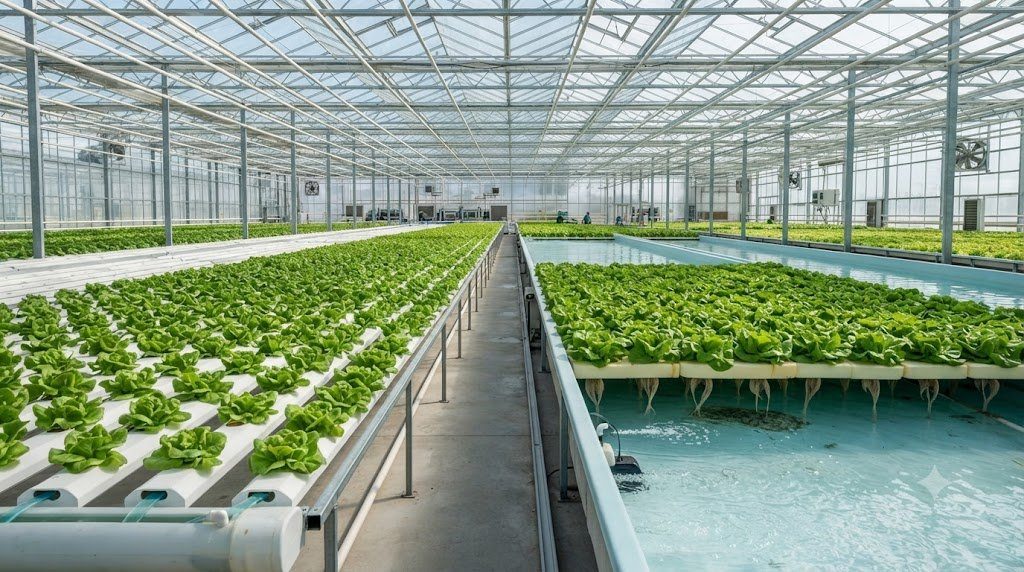
1. The Nutrient Film Technique (NFT) Matrix: Developed by Dr. Allen Cooper at the Glasshouse Crops Research Institute in England, NFT cultivates crops within rigid, food-grade extruded PVC or polypropylene channels (gullies), typically 100 to 150 mm wide with flat ribbed bottoms. Gullies are mounted on structural galvanized steel benching frames with a continuous, precision-engineered slope of 1:30 to 1:40 (2.5% to 3.3% grade).
A continuous, shallow ‘film’ of nutrient solution is pumped to the elevated top end of each channel, trickling downward over the root mass under gravity at a calibrated flow rate of 1.5 to 2.0 liters per minute before discharging into a return manifold. The water depth within the gully is maintained at a razor-thin 1.0 to 3.0 millimeters. The upper two-thirds of the developing root mass remains suspended in the humid airspace inside the gully, while only the lower third rests within the flowing liquid stream.
2. The Deep Water Culture (DWC) Raft Architecture: In contrast, DWC relies on massive, stationary rectangular concrete or lined timber ponds measuring 30 to 100 meters long, 3 to 10 meters wide, and 300 to 450 millimeters deep. Thousands of food-grade high-density polystyrene (HDPE) rafts float directly on the water surface. Crops sit in perforated net cups embedded in the floating boards, with their entire root systems completely submerged within the massive 300-mm deep liquid water reservoir.
Water moves through a DWC pond at ultra-slow laminar velocities (hydraulic retention time of 2 to 4 hours), circulating through external pump filtration loops, UV sterilizers, and liquid oxygen injection manifolds before re-entering the opposite end of the pond.
| Engineering Metric / Parameter | Nutrient Film Technique (NFT) Gullies | Deep Water Culture (DWC) Raft Ponds | Agronomic & Operational Advantage |
|---|---|---|---|
| Water Volume per Square Meter | Low (3 – 5 Liters / m²) | Massive (300 – 450 Liters / m²) | DWC provides 100x greater thermal and chemical inertia |
| Root Oxygenation Mechanics | Passive direct atmospheric diffusion | Active continuous liquid aeration / micro-bubbles | NFT roots breathe natural air; DWC requires continuous pumps |
| Thermal Mass & Temperature Swings | Fast (Water tracks greenhouse air in 2 hrs) | Slow (Buffers temperature across 48+ hours) | DWC roots remain cool in summer without active chillers |
| Pump Failure Buffer Time | Critical Hazard (< 30 – 45 min until wilting) | Immense Resilience (48 – 72 hrs survival) | NFT crops die within an hour of pump electrical failure |
| Automation & Harvesting Scalability | Moderate (Manual or mechanized benching) | Exceptional (Automated raft conveyers) | DWC rafts glide effortlessly across water to packing shed |
| Spatial Capital Cost (Capex) | $45 – $75 per m² (Benches, gullies, piping) | $85 – $140 per m² (Concrete civil works, liners) | NFT requires significantly lower civil engineering capital |
2. Root Oxygenation Physics: Boundary Layers and Dissolved Oxygen (DO)
The primary biological determinant of root health and nutrient absorption velocity in water-based hydroponics is Dissolved Oxygen (DO) availability at the root cellular membrane surface:
1. NFT Passive Oxygenation Dynamics: NFT achieves root aeration naturally through the physics of thin-film fluid mechanics. Because the flowing water layer is only 1 to 3 mm deep, atmospheric oxygen diffuses across the enormous surface-area-to-volume ratio of the water film instantly. More importantly, the upper 70% of the root mat hangs in the humid air cavity inside the gully, directly absorbing gaseous atmospheric oxygen (which contains 210,000 ppm of O₂) with zero liquid diffusion barriers! As long as water continues flowing, NFT crops never suffer root oxygen starvation.
2. DWC Active Oxygenation and the Boundary Layer Barrier: In DWC, roots are completely submerged in liquid water. At 20°C (68°F), water saturated with air can hold a maximum of only 9.1 mg/L (9.1 ppm) of dissolved oxygen—less than 0.005% of the oxygen concentration found in atmospheric air! Furthermore, living roots rapidly consume the dissolved oxygen in the stagnant liquid layer immediately surrounding their root hairs, creating a depleted unstirred boundary layer.
To prevent root suffocation, commercial DWC facilities must maintain active mechanical aeration 24/7/365:
- Venture Aeration & Air Stones: Regenerative blowers pump compressed air through ceramic micro-diffuser plates across the pond floor, generating millions of rising bubbles.
- Industrial Nanobubble Oxygen Generators: High-tech facilities inject pure liquid oxygen (LOX) through high-shear nanobubble generators, producing microscopic bubbles (100 to 200 nm diameter) that remain suspended in the water column for days, maintaining DO levels at a super-saturated 12.0 to 16.0 mg/L, accelerating root growth rates by 15% to 20%.
⚠️ Commercial Threshold: The 6.0 mg/L Dissolved Oxygen Red Line
In commercial DWC production, dissolved oxygen must never drop below 6.0 mg/L (ppm). When DO drops beneath 5.0 mg/L, root ATP production stalls, calcium transport ceases (inducing instantaneous tipburn in lettuce hearts), and zoospores of Pythium ultimum become biochemically attracted to root exudates, triggering catastrophic root rot outbreaks.
3. Thermal Mass Thermodynamics: Water Temperature Buffering
In hot summer months or freezing winter nights, root-zone temperature stability is paramount. The thermodynamic behavior of NFT versus DWC illustrates the profound impact of water volume:
The NFT Thermal Volatility Vulnerability: A commercial 1-hectare NFT installation holds only 30,000 to 50,000 liters of total water. Because this small water volume flows through thin plastic channels exposed to ambient greenhouse air and solar radiation, water temperature tracks air temperature rapidly. On a 32°C (90°F) summer day, NFT water temperatures can soar past 28°C (82°F) within 2 hours. At 28°C, oxygen solubility in water drops by 25%, while root cellular respiration rates double, creating an acute internal oxygen crisis.
The DWC Thermal Flywheel: In contrast, a 1-hectare DWC pond contains a massive 3,500,000 to 4,500,000 liters of water! The immense specific heat capacity of water (4.184 kJ/kg·K) creates an extraordinary thermal flywheel. The water temperature in a DWC pond fluctuates by less than 0.5°C to 1.0°C over a complete 24-hour cycle, completely insulating crop root systems from blistering daytime heat spikes and sub-zero nighttime chills without the massive electrical chiller energy required by NFT.
4. Pathogen Epidemiology: Pythium Root Rot Dynamics
Waterborne root diseases—predominantly Pythium Root Rot (Pythium ultimum, Pythium aphanidermatum)—represent the primary biological threat in water culture:
- NFT Pathogen Dynamics: In NFT gullies, if Pythium infects a channel, its motile biflagellate zoospores travel downstream, infecting every plant within that individual gully. However, because each gully is an isolated linear trough, the disease is physically contained. Furthermore, because the root system is small, an infected channel can be rapidly removed, sanitized, and re-planted in minutes with zero disruption to neighboring benches.
- DWC Pathogen Disaster Potential: In DWC, a single infected seedling raft introduces zoospores into a shared 4-million-liter open pond. The gentle circulating water currents distribute zoospores to every floating raft across the entire facility. If water temperatures rise past 24°C and DO drops below 6.0 mg/L, Pythium can eradicate an entire 1-hectare crop of lettuce within 5 to 7 days! Managing DWC mandates continuous inline UV-C photolysis reactors (250 mJ/cm²) and bi-weekly colonization of roots with beneficial bio-fungicides such as Trichoderma harzianum or Bacillus amyloliquefaciens.
5. Mechanized Logistics and Automated Raft Harvesting
Where DWC reigns supreme in commercial unit economics is Labor Logistics and Automated Harvesting:
The Floating Conveyor Advantage: In a commercial DWC pond, water acts as a zero-friction conveyor belt. Floating polystyrene rafts weighing hundreds of kilograms can be pushed across a 100-meter pond with the gentle touch of a single worker’s hand! Seedling rafts are placed into the water at the germination end of the pond; as mature heads are harvested at the opposite end, the entire field of rafts is indexed forward. The harvest process takes place in a climate-controlled central packing shed: an automated mechanical crane lifts floating boards out of the water, robotic cutters slice lettuce heads from root balls, and automated washers sanitize boards before restacking. Labor efficiency in DWC is 40% to 60% higher than in traditional fixed-bench NFT facilities.
6. 10-Year Financial Feasibility and Capex/Opex Economics
Conducting a comprehensive financial feasibility assessment reveals distinct economic niches for both technologies:
- Capital Expenditure (Capex): Building a commercial DWC facility requires extensive civil engineering: massive ground excavations, laser-leveled concrete grade beams, reinforced geomembrane liners, and millions of liters of initial water volume, resulting in an initial Capex of $85 to $140 per square meter. NFT benching systems, requiring simple post supports and roll-formed galvanized frames, cost only $45 to $75 per square meter—making NFT the preferred platform for small-to-mid-scale commercial growers and greenhouse retrofits.
- Operational Return on Investment (ROI): For large-scale mega-facilities (> 2 hectares) focused on commodity head lettuce and packaging for major supermarket chains, the immense labor savings and mechanized harvesting efficiency of DWC generate a superior Return on Invested Capital (ROIC) within 3.5 to 4.5 years. For specialty culinary herbs (basil, cilantro, mint) and mixed specialty greens where crop turnover is rapid and channel flexibility is required, NFT remains the undisputed commercial leader.
7. Nutrient Film Technique Channel Geometry and Root Damming Physics
A classic mechanical failure mode in poorly engineered NFT installations is Root Damming. As leafy green crops approach harvest maturity at 28 to 35 days, root masses expand into dense fibrous blankets filling the channel bottom. In narrow curved or rounded pipes (such as cheap PVC plumbing pipes), this root mass acts as a physical dam.
Water backs up behind the root dam, drowning the upper root mass in stagnant anaerobic water, while overflowing the tops of the channels and spilling onto the floor. Commercial NFT engineering prevents root damming by utilizing wide, flat-bottomed trapezoidal channels with longitudinal capillary ribs along the floor. The ribs elevate root mats 1.5 mm above the channel bed, allowing water to glide smoothly beneath the root blanket even under maximum harvest biomass loads.
8. Tipburn Mitigation and Calcium Translocation in High-Density Rafts
In high-density commercial lettuce production, Tipburn (localized calcium deficiency necrosis of young inner heart leaves) is the primary cause of unmarketable crop culls. Because inner heart leaves are tightly enclosed by outer leaves, they transpire very little water, receiving minimal calcium delivery.
To eliminate tipburn in DWC and NFT operations, facilities install Overhead Vertical Air Flow (VAF) Nozzles pointed directly down at developing lettuce heads. High-velocity air jets (0.5 to 0.8 m/s) penetrate the inner canopy hearts, stripping the humid boundary layer and stimulating localized heart transpiration. This targeted transpirational pull drives calcium-rich xylem sap directly into rapidly expanding heart cells, completely eradicating tipburn without requiring chemical foliar calcium sprays.
9. Automated Floating Raft Sanitation and Biofilm Decontamination
A critical sanitary challenge in continuous commercial DWC production is the maintenance of floating foam boards. High-density extruded polystyrene boards spend months in contact with warm, nutrient-rich water and intense supplemental lighting, leading to the rapid accumulation of green algal biofilms, mineral crusts, and organic root residues in cup apertures.
High-tech DWC facilities route harvested raft boards through Automated Multi-Stage Tunnel Washers. The boards are subjected to high-pressure rotating jet sprays (40 bar) delivering 60°C wash water blended with food-grade peracetic acid (PAA) and quaternary sanitizers, followed by high-intensity UV-C radiation chambers. This automated decontamination protocol eradicates fungal spores and human bacterial pathogens (Listeria monocytogenes, Salmonella) without degrading the structural buoyancy of the boards, guaranteeing pristine food safety compliance across millions of harvested lettuce heads annually.
10. Automated Water Chemistry Monitoring and Ion-Selective Field Sensor Calibration
Modern commercial leafy green facilities are transitioning from manual bench testing to continuous inline water telemetry. In large-scale NFT gullies and DWC ponds, automated sensor manifolds continuously measure dissolved oxygen (DO), electrical conductivity (EC), pH, and temperature, transmitting real-time readings directly to the greenhouse supervisory control and data acquisition (SCADA) network.
Because nutrient film channels and raft ponds operate with dynamic microbial populations, sensor probes develop organic biofilm coatings that cause measurement drift within 48 to 72 hours. High-tech facilities incorporate Automated Ultrasonic Cleaners and Air-Blast Scrubbers integrated into sensor flow cells. Periodic automated cleaning cycles, coupled with weekly two-point buffer calibration routines (pH 4.01 and 7.00; EC 1.413 mS/cm), ensure sensor measurement accuracy within ± 0.02 pH and ± 0.05 mS/cm, safeguarding delicate root systems against inadvertent chemical over-dosing.